Nature
Coastal dunes
Dunes up to 160 metres high, home to the silver dik-dik and rare endemic larks.

An ancient Indian Ocean port and former seat of the Sultanate of Hobyo, set among towering coastal dunes that are home to rare wildlife.
Hobyo (Italian: Obbia) is a coastal town in Mudug region, Galmudug State, and the seat of Hobyo District. For centuries it has served as a port for central Somalia, and it is famous as the former capital of the Sultanate of Hobyo.
The town is surrounded by one of Somalia's most striking landscapes: coastal dunes up to 160 metres high in a belt 10 to 15 km wide. These dunes are home to the silver dik-dik and to birds found nowhere else, including the Obbia lark, which takes its name from the town.
Hobyo has a small seaport serving the town, and in recent years plans have been announced to build a new, modern port.
Dunes up to 160 metres high, home to the silver dik-dik and rare endemic larks.
A long Indian Ocean shoreline of sand, with the old harbour at its heart.
The old harbour that served the trade of the Ajuran, the Hiraab Imamate and the Sultanate of Hobyo.
Hobyo was founded as a coastal outpost of the Ajuran state, around the 13th century. In the late 17th century the Hiraab broke away from the Ajuran and established the Hiraab Imamate, which ruled the area for a long period. The port exported livestock, hides and aromatic woods and imported rice, other foodstuffs and cloth.
In the late 19th century Sultan Yusuf Ali Kenadid founded a sultanate at Hobyo. In 1888–1889 he signed a protectorate treaty with Italy, and the sultanate had its own administration, flag and standing army. Relations with Italy broke down when the sultan refused to let British troops land in his territory, and he and his son Ali Yusuf were sent into exile. After the Italian campaigns of 1925–1927 the sultanate was absorbed into Italian Somaliland.
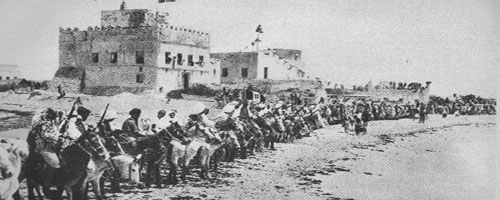
The sultanate's history, from its well-known cavalry to the fort by the harbour, is documented in photographs from the 1920s that show horsemen lined up before a white fort on the shore.
Historically Hobyo's economy rested on seaborne trade and livestock exports. In 2019 Qatar announced a partnership to build a new port at Hobyo, and further investment deals have since been proposed, all aimed at making Hobyo a sea gateway for central Somalia.