Beach
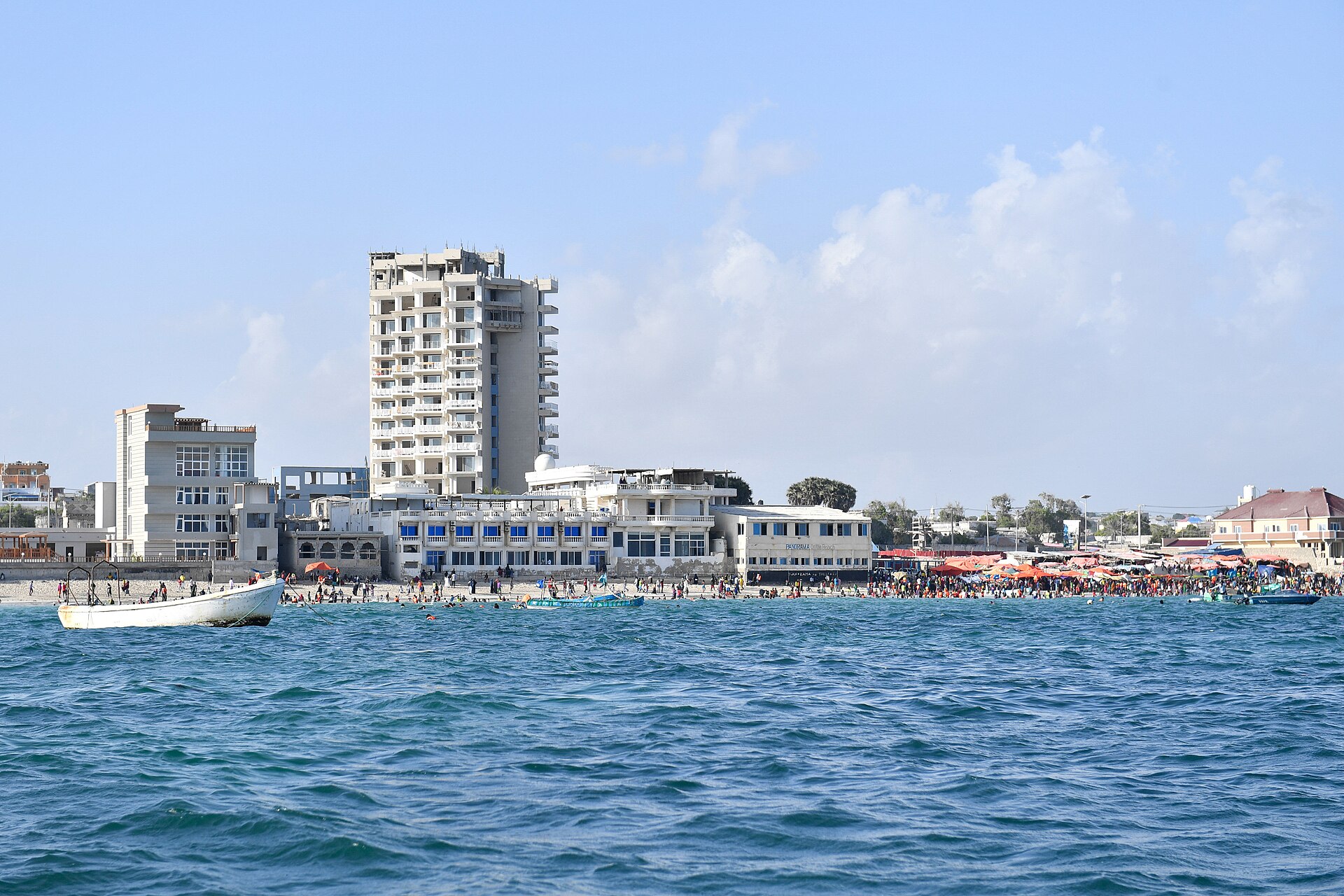
Lido Beach
Mogadishu's best-known beach, lined with seafood restaurants and hotels and packed with families at weekends.

Somalia's capital and largest city on the Indian Ocean: centuries-old quarters and mosques, the busy Lido beachfront, vast markets and a skyline being rebuilt at speed.
Mogadishu, known to Somalis as Xamar, is the capital and largest city of Somalia, stretched along a bright run of Indian Ocean coastline. The city and the Banadir region are one and the same: the region's districts together make up the capital, home to the federal government, the main seaport and the country's principal international airport.
For centuries this was one of the great trading ports of the East African coast, and the old quarters of Xamar Weyne and Shangaani still hold mosques whose dated inscriptions reach back to the 13th century. Today the old town stands beside new hotels, banks and apartment blocks, as a construction boom reshapes the skyline.
Life in Mogadishu spills onto the seafront. At weekends families crowd Lido beach, fishermen haul their boats up at the old harbour, and the markets, from sprawling Bakaara to neighbourhood stalls, trade in everything from cloth and spices to phones and electronics.
Mogadishu's best-known beach, lined with seafood restaurants and hotels and packed with families at weekends.
One of the two historic quarters of the old city, with narrow lanes, old stone houses and the medieval Friday mosque.
The other historic core of old Mogadishu, right by the sea; historians consider it the older of the two quarters.
Its minaret carries an inscription dated 1238, one of the oldest dated Islamic monuments in the city.
Founded around 1268–69; the inscription in its mihrab names its founder, Khusraw ibn Muhammad al-Shirazi.
Built in 1269, as an inscription records, and admired for its formal plan and vaulted roof.
A landmark white mosque completed in 1987 with Saudi funding, among the largest in the Horn of Africa.
Reopened on 1 July 2020 after nearly 30 years; its collection of Somali heritage is being rebuilt.
Opened in 1967 and reopened in 2020 after reconstruction; a stage for Somali drama, music and national events.
A vast open-air market founded in the early 1970s, selling everything from cloth and spices to food and electronics.
One of the two historic quarters of old Mogadishu.
A newer district on the western side of the city.
The historic seafront quarter, considered the oldest part of the old city.
This list contains verified names; editors keep adding more.
Mogadishu was already a town of note when the geographer Yaqut described it in the early 13th century. Inscriptions in its oldest mosques date the minaret of the Friday mosque in Xamar Weyne to 1238 and the Arba'a Rukun and Fakr ad-Din mosques to 1268–69. When the traveller Ibn Battuta arrived around 1331 he found a large, prosperous town ruled by a sultan, Abu Bakr ibn Shaikh Umar, and famous for woven cloth exported as far as Egypt. The city struck its own copper coins in the 14th century, and Chinese fleets under Zheng He called here in the early 1400s.
Portuguese ships reached Mogadishu in 1499, and their later attempts to seize the city failed. In the 19th century the Sultan of Zanzibar claimed the coast while the inland Geledi sultanate held real sway over trade. Zanzibar leased the Benadir ports to Italy in 1892; from 1905 Mogadishu was the capital of Italian Somaliland, and from 1950 to 1960 it was the seat of the UN trust territory administered by Italy.
On 1 July 1960 Mogadishu became the capital of the independent Somali Republic. The civil war that began in 1991 left deep scars, but since the early 2010s the city has been rebuilding, with diaspora investment and new construction transforming district after district.
Mogadishu is the cultural heart of the country. The National Museum of Somalia reopened on 1 July 2020 after almost three decades of closure, and the National Theatre, first opened in 1967, was rebuilt and reopened the same year. The old Benadiri quarters keep their narrow lanes and historic mosques, and the city has long been a centre of Somali poetry, music and media.
Religious life gathers around mosques old and new, from the medieval Arba'a Rukun to the Mosque of Islamic Solidarity, completed in 1987. Weekends and Eid holidays bring crowds to the beaches, where families settle on the sand and children play football by the water.
As the seat of government and one of the country's main seaports, Mogadishu is the hub of Somalia's economy. It is home to the Central Bank, the largest telecom companies, banks and money-transfer firms. Bakaara market, one of the biggest in the country, has long been a barometer of national trade.
Fishing still matters along the coast, while construction, hotels and services have grown fast as investors and returning diaspora families rebuild homes, hotels and offices.